Table of Contents
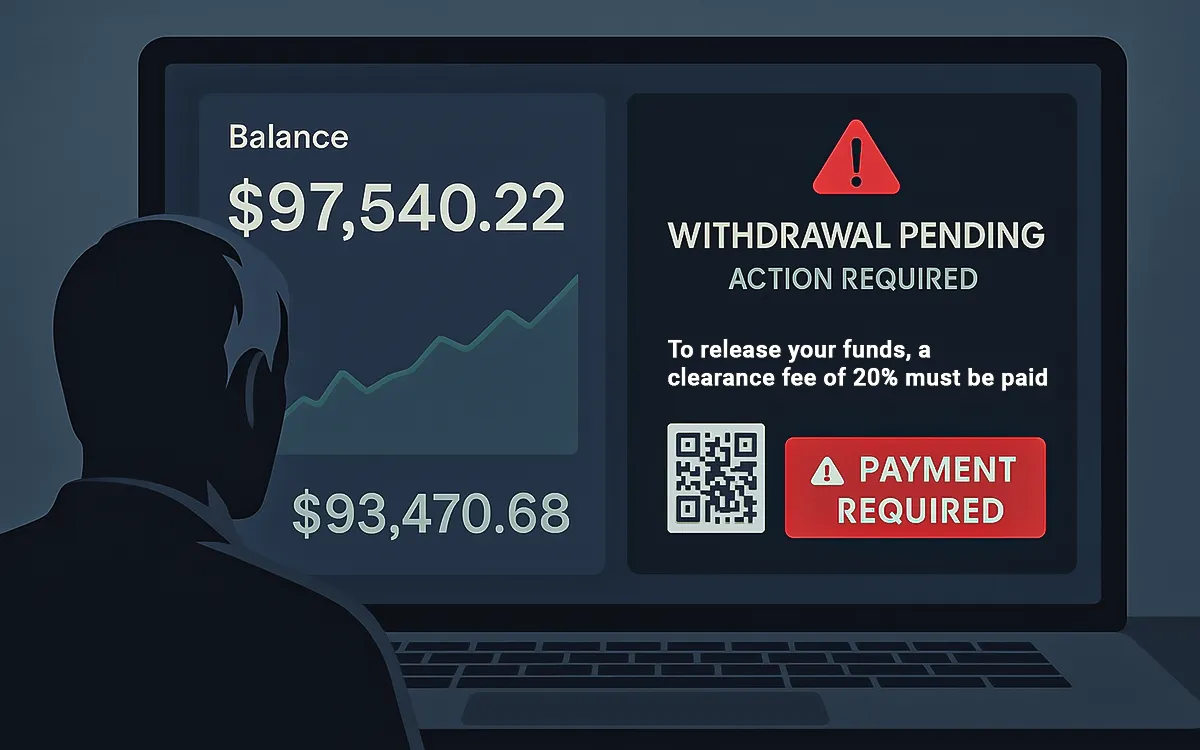
Crypto withdrawal fee scams often become visible when an investor attempts to access funds shown in an online account. A platform may display substantial profits and then demand a separate payment before processing the withdrawal. These unexplained withdrawal chargesare described as a withdrawal fee, tax, compliance charge, verification fee, or processing cost.
Victims may believe their crypto funds remain locked until a fee is paid. However, the displayed account balance may not represent money that can actually be withdrawn. Instead, it may be part of a fraudulent platform designed to appear legitimate and encourage further payments.
Understanding how these scams operate can help identify suspicious withdrawal demands, preserve important evidence, and reduce the risk of further financial loss.
Crypto withdrawal scams are a type of cryptocurrency fraud in which scammers demand payment or personal information before allowing victims to withdraw their supposed crypto funds.
Crypto withdrawal scams are some of the most financially manipulative and emotionally devastating scams out there. Unfortunately, many victims are often caught up in similarcrypto investment scams that follow the same pattern of false profit claims and fake fees. In this type of scam, scammers follow a fixed pattern. Understanding this pattern will help you identify the scam in the early stage.
In a crypto withdrawal scam, scammers demand payment to release funds from you. They work in a very organized, sophisticated manner to delude you. The following points show how this scam takes place.
Scammers do more than just asking for money. They create an experience that looks and feels legitimate. Fake crypto platforms often copy the design, features, and language used by trusted services.
They build a false sense of security, display live crypto prices, and fake dashboards. They use formal language, official-looking websites, and fake legal documents. Their customer support teams respond quickly and use very professional language. Some platforms even allow a small withdrawal at first. This can make the service appear genuine and encourage larger deposits.
These tactics are designed to build trust. By the time a large withdrawal or processing fee is requested, the payment may seem like a normal part of the process rather than a warning sign.
Fake withdrawal fee scams can take different forms. The excuse may change, but the goal is usually the same. Convince the victim to send more money before releasing funds that do not actually exist.
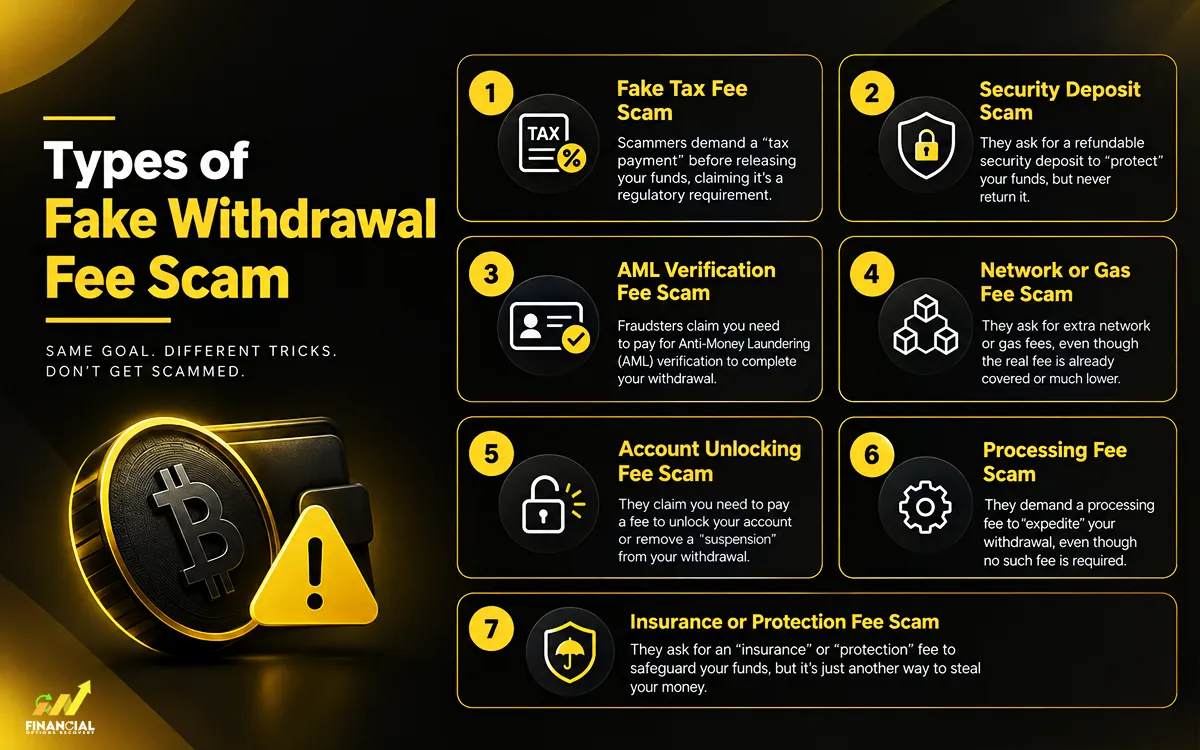
Scammers claim that taxes must be paid before cryptocurrency profits can be withdrawn. They may provide fake tax notices, invoices, or payment instructions to make the demand appear legitimate. Learn more aboutcrypto tax scams and the warning signs associated with fake tax demands.
Example:
“Your account has generated $25,000 in profits. A 10% crypto tax payment is required before your withdrawal can be processed.”
In this scam, the platform claims that a security deposit is required before a withdrawal can be processed. Scammers may describe the payment as temporary or refundable to make it seem less suspicious. They may say the deposit is needed to verify the account, protect the transaction, or meet security requirements. The promised refund may never arrive.
Example:
“To complete your withdrawal, please deposit $2,000 as a temporary security verification fee. The amount will be refunded after approval.”
Scammers may use anti-money laundering (AML) procedures as a reason to demand an additional payment. The platform might claim that the withdrawal has been flagged and requires special verification. The use of professional financial terminology can make the request appear genuine. However, the fee may simply be another tactic to obtain money from the victim.
Example:
“Your withdrawal has been flagged for AML verification. Pay the $1,500 compliance fee to release your funds.”
Scammers claim that a separate blockchain network or gas fee must be paid before a withdrawal can proceed. They may provide a specific amount and create urgency by saying the transaction will otherwise expire. Victims may believe the payment is necessary because legitimate blockchain transactions can involve network fees. However, scammers can misuse this explanation to demand additional money.
Example:
“Your withdrawal is ready, but a $750 network fee must be paid before the transaction can be broadcast to the blockchain.”
A platform suddenly claims that the victim’s account has been frozen, restricted, or flagged for suspicious activity. Scammers then demand an account unlocking or restoration fee before allowing the withdrawal. Victims who believe their funds are still accessible may pay the requested amount.
Example:
“Your account has been temporarily locked due to unusual activity. Pay the $1,000 account restoration fee to unlock your withdrawal.”
Scammers may present a large payment as a standard withdrawal or processing fee. The charge can appear legitimate because genuine financial platforms sometimes have transaction fees. However, the requested amount is introduced only after the victim attempts to withdraw.
Example:
“Your withdrawal request has been approved. A 5% processing fee of $2,500 must be paid before the funds can be transferred.”
Scammers claim that cryptocurrency must be insured before it is transferred to the victim's wallet. They say that the payment covers transaction protection, fraud insurance, or transfer security. This sounds convincing because insurance is commonly used in traditional financial services. The victim may therefore believe the charge is a normal requirement.
Example:
“Your withdrawal requires transaction insurance. Please pay $1,200 to protect the transfer and release your funds.”
The repeated demands are an important warning sign. Paying one fee does not guarantee that the platform will release the funds or stop requesting additional payments. Understand withdrawal fee scams in depth with the help of a case study given below.
No matter how professional a crypto platform looks, it still can’t cover all the loopholes of a fake platform. Check out for these red flags if you’re unsure whether a crypto platform is genuine.
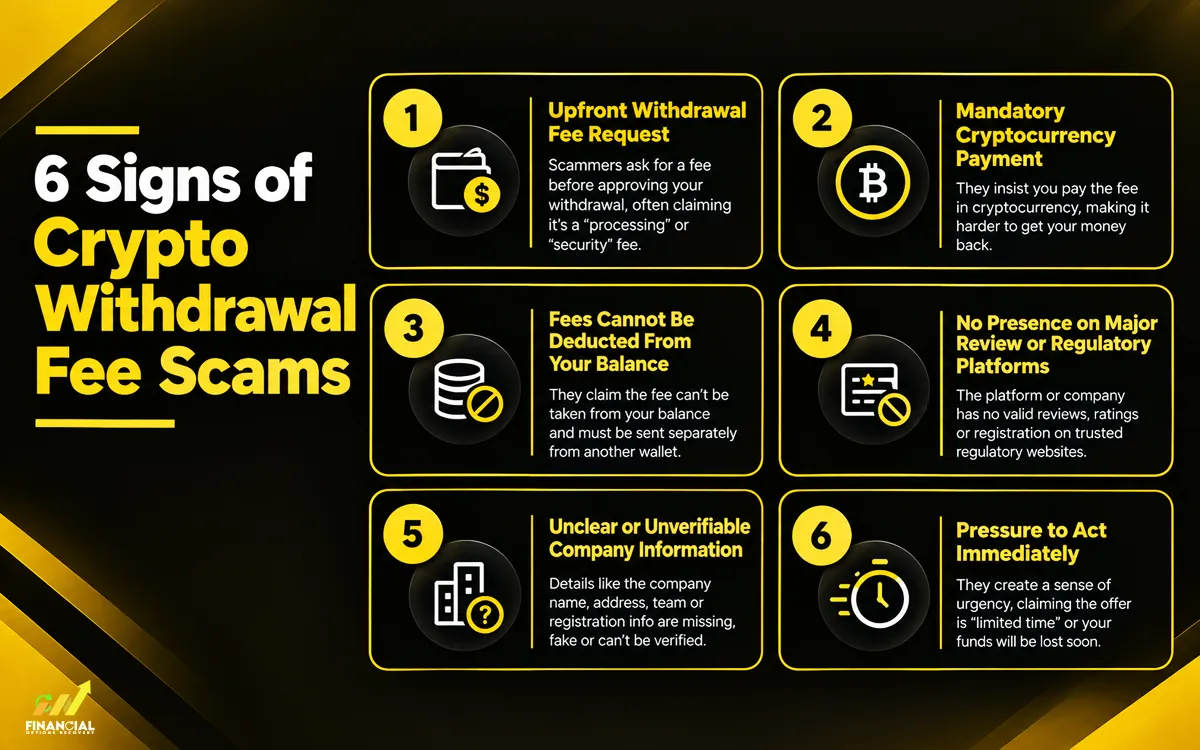
Legitimate exchanges don’t request manual payments before releasing your funds. Fees are typically deducted automatically from your withdrawal or trading balance, never sent separately.
Crypto payments are fast, irreversible, and difficult to trace, which is why scammers insist on using cryptocurrency as a mode of payment. This is a common tactic to avoid detection and eliminate any chance of refunds.
Even if your dashboard shows thousands in profit, they’ll claim they can’t deduct the fee internally. Instead, they push you to send it manually, usually to an external wallet.
Reputable exchanges are listed on sites like Trustpilot or CoinMarketCap or have clear regulatory information. If you can’t find reliable reviews or verifiable registration details, that’s a red flag.
Scam platforms may provide vague company details, fake office addresses, or nonexistent licenses to appear legitimate. Before depositing funds, verify the company’s legal name, registration details, physical address, and any claimed licenses through official sources.
Scammers often create a false sense of urgency with messages such as “Withdraw now or your account will be frozen” or “Pay the fee today to release your funds.” This pressure is designed to discourage careful verification and encourage quick payments. Legitimate financial services provide clear terms rather than demanding immediate action.
Taken together, these warning signs can indicate a potential scam, so verify the platform independently before sending any money or cryptocurrency. Recognizing the warning signs is only the first step in protecting yourself from scammers.
Protecting yourself from crypto withdrawal scams starts with verifying the platform, understanding its withdrawal process, and recognizing common warning signs before sending any funds.
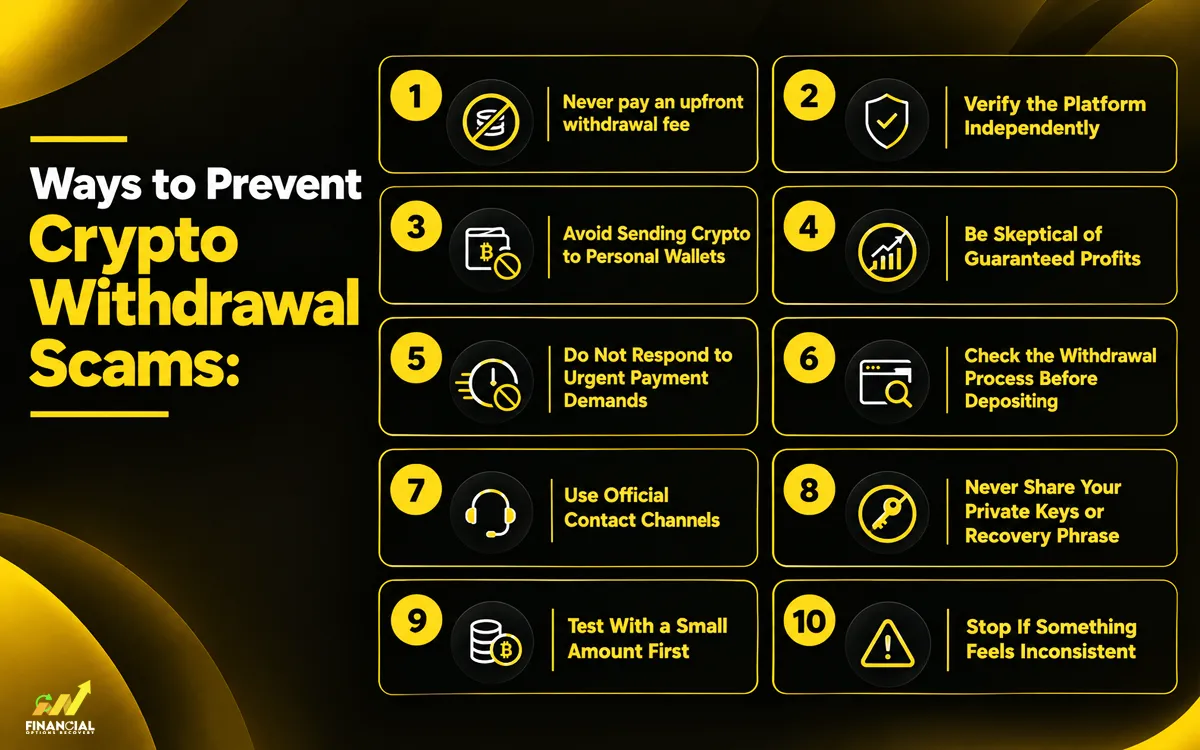
Be cautious if a platform asks you to make a separate payment before releasing your cryptocurrency. Verify the fee through official terms and support channels before sending any additional funds.
Before depositing money, research the platform beyond its own website. Check its registered company name, licensing information, domain, and reputation through trusted, independent sources.
Be careful if someone asks you to send cryptocurrency to a personal or unfamiliar wallet to release your funds. Confirm any payment request through the platform’s official support channels first.
Be wary of platforms promising guaranteed profits or unusually high returns with little or no risk. Cryptocurrency investments can fluctuate significantly, so guaranteed returns should be treated as a warning sign.
Scammers often use urgency to prevent people from thinking through a payment request. If you are threatened with account closure or frozen funds, pause and verify the claim independently.
Read the platform’s withdrawal terms before putting money into an account. Look for information about fees, withdrawal limits, identity checks, processing times, and any conditions that could affect access to your funds.
If you encounter a withdrawal problem, contact the platform through its verified website or official app. Avoid relying on unsolicited emails, social media messages, or individuals claiming to be support agents.
Your private key and recovery phrase can provide access to your crypto assets. Never share them with a supposed exchange representative, customer-support agent, or anyone claiming they need them to process a withdrawal.
When using a platform you have not used before, consider starting with an amount you can afford to lose. Confirm that deposits and withdrawals work as expected before committing larger sums.
If new taxes, verification fees, unlocking charges, or other unexpected payments keep appearing, stop before sending more money. Review the platform independently and seek reliable advice if necessary.
By staying cautious, verifying information independently, and refusing unexpected payment demands, you can reduce the risk of losing your cryptocurrency to a withdrawal scam.
It is never too late to act. As soon as you realize you have been targeted, stop making further payments and follow the steps below to protect yourself.
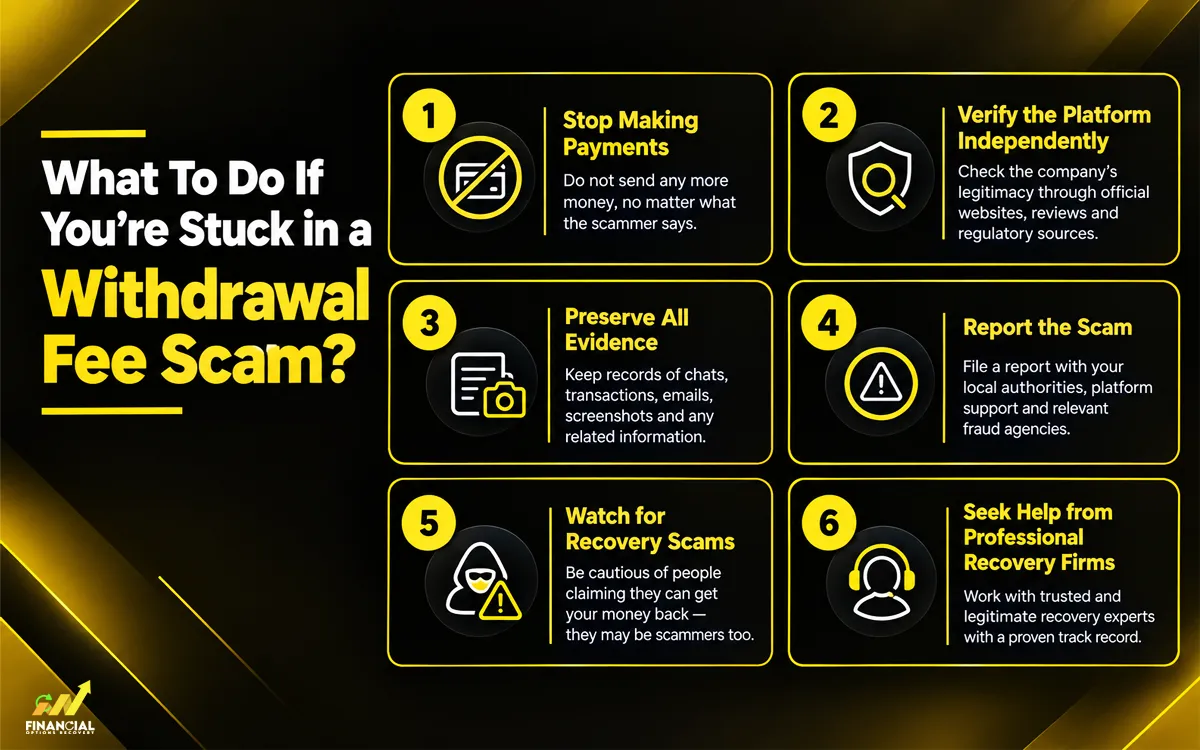
Do not send another payment simply because the platform claims it is the final fee. Scammers may use different explanations, such as taxes, compliance charges, verification fees, or account-unlocking costs.
Save the payment request and avoid sharing additional wallet details, passwords, or personal information until the situation is reviewed.
Do not rely only on the platform’s website or customer support for verification. Search for the company name along with terms such as "scam," "fraud," "withdrawal problem," or "complaint."
Check whether the platform is registered or regulated where it claims to operate. Be especially cautious when its contact details, registration information, or company identity cannot be independently confirmed.
Save everything connected to the transaction before the website disappears or your account becomes inaccessible.
This may include:
This information can help establish how the funds moved and provide useful evidence when reporting the incident. If cryptocurrency was transferred during the scam, learning how to trace stolen crypto can also help you understand what information may be relevant when reviewing blockchain transactions.
Reporting the incident creates an official record and may help authorities identify related fraudulent activity. In the United States, victims can report fraud to the Federal Trade Commission (FTC) and internet-related crimes to the FBI’s Internet Crime Complaint Center (IC3).
When reporting, provide as much transaction and communication evidence as possible.
After losing money, victims may be contacted by people claiming they can recover the cryptocurrency. They may ask for an upfront fee, tax payment, wallet-access charge, or other deposit.
This can become a second scam targeting someone who has already suffered a loss. Be cautious of anyone who guarantees recovery or demands payment before explaining what can realistically be done.
If you’ve lost funds, consider reaching out to reputable recovery firms that specialize in crypto fraud cases. A qualified firm like Financial Options Recovery LLC can review the available evidence, assess the transaction history, and explain the recovery options that may be available without making unrealistic promises.
Scams like these don't exist only in theory; they're happening every day to real people. Scammers are using clever tactics that sound official and believable.
To make you understand this better, here’s a recent case that shows just how serious and convincing these scams can be.
$210K Recovered After AI Crypto Withdrawal Scam
Steve, a Boston resident, invested $350,000 in an automated crypto trading platform that claimed to offer AI-driven trading and consistent returns. The platform initially appeared legitimate. He could track trades, see profits, and make small withdrawals, which encouraged him to invest more.
When Steve attempted to withdraw $50,000, the platform suddenly blocked the transaction, citing international compliance regulations. Support then demanded a $35,000 compliance fee, claiming it was required to release his funds. Despite his concerns, Steve made the payment.
The withdrawal was never processed. Soon after, the website went offline, his account was frozen, and the advisor who had regularly contacted him stopped responding.
While searching for assistance, Steve found Financial Options Recovery LLC. Their team reviewed his wallet addresses, transaction records, screenshots, emails, and other evidence. Blockchain tracing was then used to examine the movement of his funds. The investigation found that part of the money had moved through centralized exchanges.
Around six weeks later, Steve was informed that $210,000 had been recovered, while efforts to trace the remaining funds continued. The case highlights how fake compliance fees can be used to extract additional payments from victims of crypto withdrawal scams.
Withdrawal fee scams often work because they create pressure, urgency, and fear. Scammers use pressure to make victims act before they have time to question the situation.
Recognizing these psychological tactics can make it easier to pause and assess what is happening. Do not let the fear of losing your displayed balance push you into making more payments. Preserve your records, report the scam, and seek guidance from qualified professionals when needed. Taking a careful and informed approach can help prevent further financial loss and support the next steps toward addressing the incident.
In case you've been targeted or worse, lost money, you’re not alone. In case you've fallen victim and need help recovering your funds, don’t hesitate to reach out to a professional recovery firm like Financial Options Recovery LLC. They specialize in helping victims get their money back and provide expert guidance every step of the way.
Protect your money and peace of mind. Contact us today for professional recovery support.
A request to send cryptocurrency to unlock your own funds is a major warning sign. Verify the demand independently before paying.
Do not pay an unexpected withdrawal fee without verifying why it is required and confirming the platform through independent sources.
Some legitimate services may charge disclosed transaction or withdrawal fees. An unexpected fee introduced only when you try to withdraw requires careful verification.
Scammers often introduce withdrawal, tax, compliance, or clearance fees when victims attempt to access funds. The FBI warns against paying additional fees or taxes to withdraw from suspected scams.
A withdrawal can be restricted for legitimate security or compliance reasons, but unexplained restrictions combined with demands for additional payments can indicate fraud.