
Table of Contents
Cryptocurrency tax scams begin with a message that sounds official. A fake investment platform claims that you owe a tax before withdrawing your funds. However, these messages are not coming from a legitimate body. Scammers find opportunities to disguise themselves as a representative.
Whether you invest, trade, or simply hold cryptocurrency, understanding how crypto tax scams work can help you recognize suspicious requests before it is too late. The damage may also extend beyond losing crypto. Scammers misuse stolen personal or financial information to impersonate you.
This guide explains how crypto tax scams work, their warning signs, what to do if you become a victim, and practical ways to protect your digital assets.
A crypto tax scam is a type of fraud in which scammers impersonate tax authorities and falsely claim that you owe taxes on your cryptocurrency holdings or profits.
They also contact you through emails, phone calls, text messages, or even official-looking letters. Cryptocurrency tax scams appear convincing at first, which makes it difficult for victims to recognize the fraud. Scammers often rely on fear and urgency. They pressurize victims to make payments immediately to avoid penalties, account restrictions, or legal action.
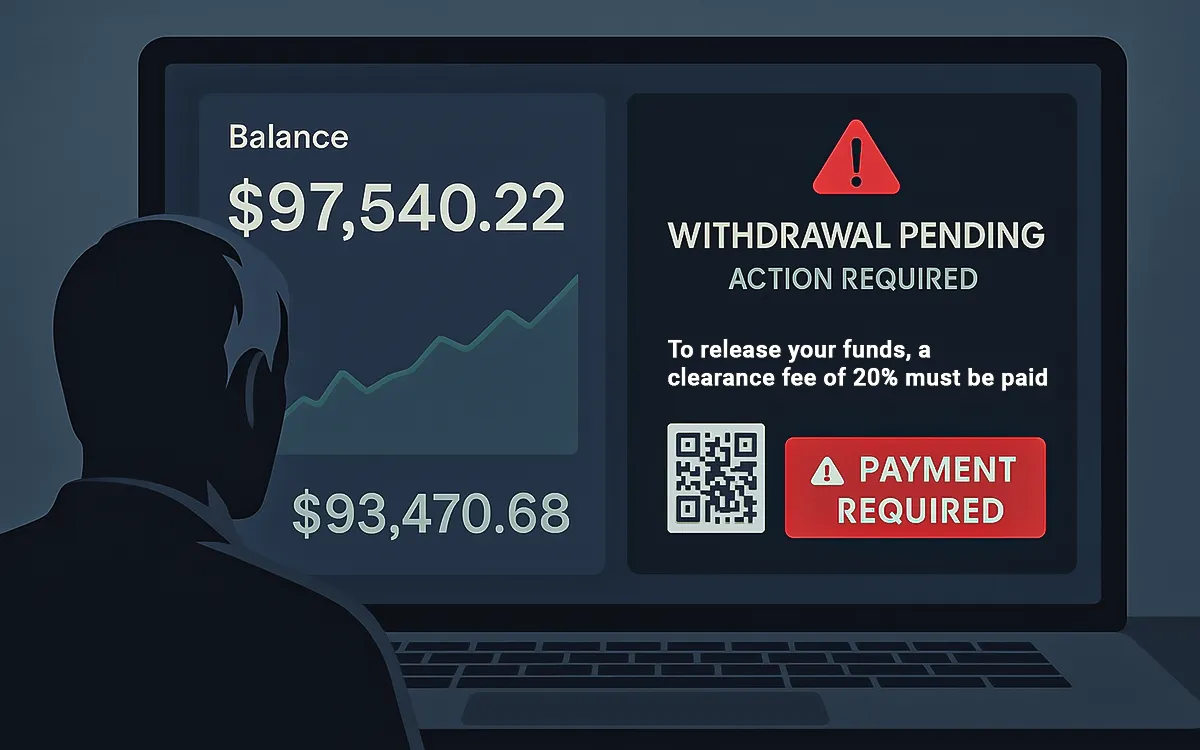
This reveals that the platform was designed to extract money through fraudulent tax fee demands rather than provide legitimate access to the investor's funds.
Crypto tax scams are effective because they combine convincing platforms with carefully designed psychological tactics. Scammers often try to make victims believe that everything is legitimate before demanding larger payments.
Some of the most common tactics include:
Together, these tactics exploit both trust and fear. By the time a victim realizes something is wrong, they already have sent substantial amounts of cryptocurrency to the scammers.
According to the FBI’s 2026 Internet Crime Report, Americans reported more than 181,000 cryptocurrency-related fraud complaints, with losses exceeding $11 billion. These figures highlight how quickly crypto scams are growing and why investors need to stay alert.
Although the underlying mechanics of crypto tax scams are always the same, scammers are clever at rebranding their requirements with different scenarios. They use words that sound official in the context of the financial and regulatory world to mislead victims into assuming these are official requirements.
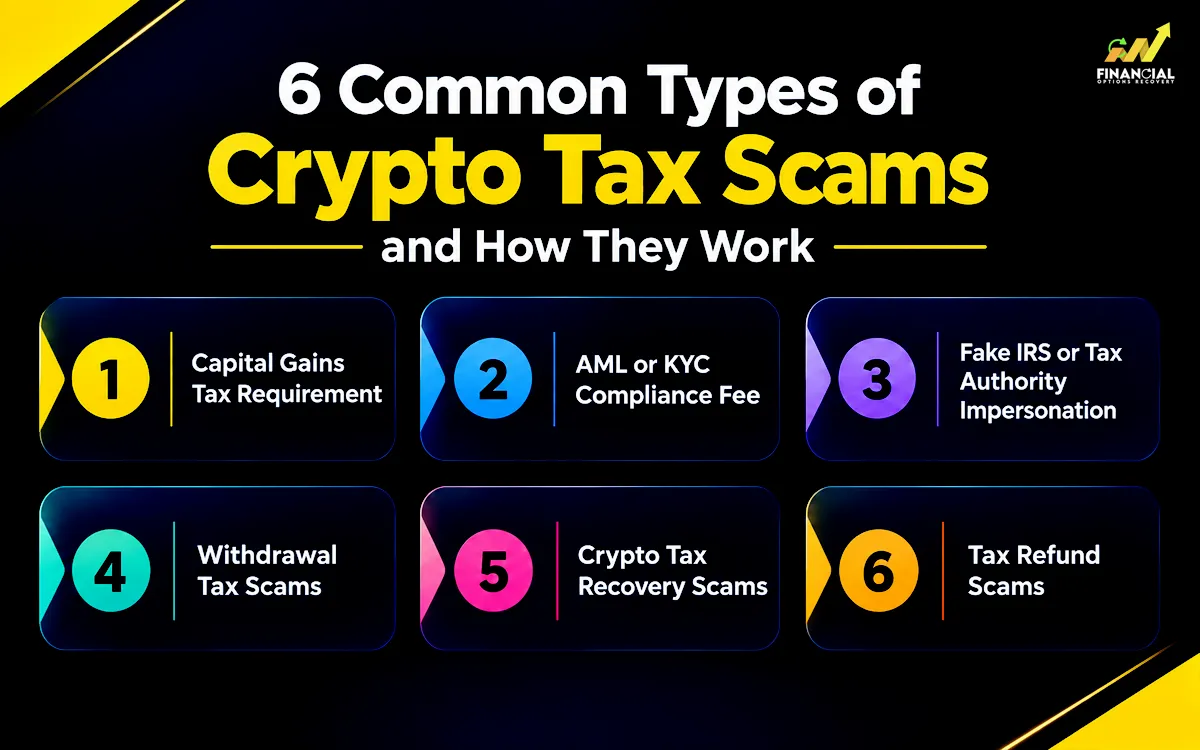
Some of the most prevalent tax-related scam varieties you may face are listed below:
Capital gains tax requirement is one of the most frequently used approaches. The scammer will inform you that your displayed "profits" are subject to capital gains tax, a legitimate concept in real financial markets. However, the demand itself is fraudulent.
Example: "Congratulations! You've earned $75,000 in profits from your crypto investments. You are required to pay tax to release crypto funds to your wallet.
Scammers often use terms such as ‘Anti-Money Laundering (AML)’ or ‘Know Your Customer (KYC)’ compliance. The terms are plucked from the real world of stringent AML and KYC processes imposed upon genuine financial agencies and crypto exchanges, only to be twisted and revealed by scammers into demands for fictitious charges for verification or clearance.
Example: Per regulatory requirements, your account is currently under review for anti-money laundering concerns. A verification fee of $5,000 is required to complete the check and unblock your withdrawal.
Scammers pretend to be officials from the IRS or another tax authority. They often use official-looking fake crypto tax notices, employee names, case numbers, or government logos to make the communication appear genuine. These threats are designed to create fear and pressure the victim into paying before verifying the claim through an official government channel.
Example: "This is an official IRS compliance notice. Your cryptocurrency transactions require immediate tax settlement. Failure to pay within 24 hours may result in penalties and enforcement action."
In a withdrawal tax scam, a fake crypto platform claims that taxes must be paid before funds can be released. The victim may see a large balance on the platform but cannot withdraw it. Instead, the platform demands a separate tax payment, often in cryptocurrency.
Example:
"Your withdrawal of $85,000 has been approved. However, a 12% cryptocurrency tax must be paid before the funds can be transferred to your wallet."
Crypto tax recovery scams typically target people who have already lost money. The scammer may claim to be a tax specialist, recovery agent, or government-linked professional who can help recover cryptocurrency through a refund or tax adjustment.
Example:
"Our tax recovery department has located your lost cryptocurrency. To release the recovered amount, you must first pay the required government recovery tax."
Tax refund scams reverse the usual approach. Instead of claiming that the victim owes money, scammers promise that the victim is entitled to a cryptocurrency tax refund. The fraudster’s requests expose victims to additional financial or identity-related risks.
Example:
"Our records show that you are eligible for a $7,500 crypto tax refund. Pay the $250 processing charge and provide your wallet address to receive your refund."
Across these schemes, scammers often combine fake authority, urgent deadlines, and additional payment demands. They also use professional-looking documents or websites to create a false sense of legitimacy.
Understanding how these scams operate is an important first step toward recognizing crypto tax scam warning signs and protecting yourself from crypto tax fee fraud.
Cryptocurrency tax scams often follow a multi-step process designed to deceive individuals into believing they have outstanding tax obligations or other financial requirements. Even experienced cryptocurrency investors can become targets of these schemes.
Understanding how cryptocurrency tax scams work can help you recognize common warning signs and avoid potential financial losses.
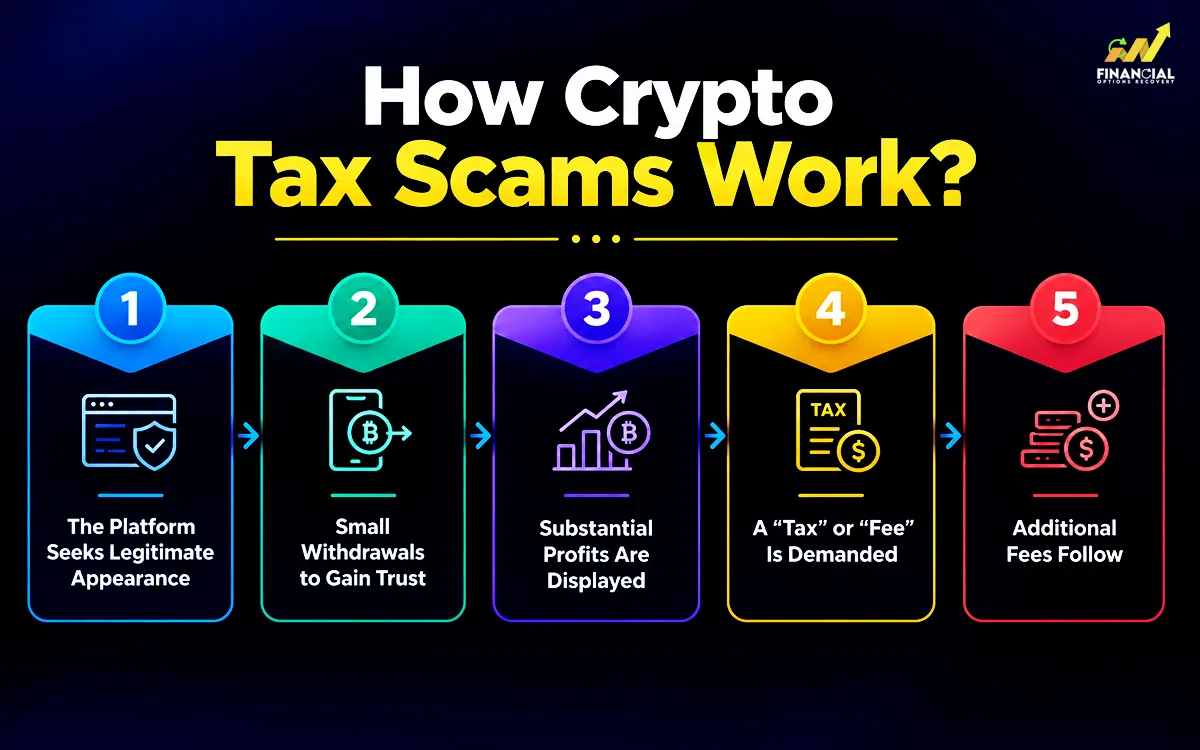
The scam typically follows a process like this:
Step 1: The Platform Seeks Legitimate Appearance
Scammers begin the scam by posting highly professional-looking websites and dashboards that closely copy genuine cryptocurrency exchanges or investment platforms. These imitation sites frequently feature realistic touches, including mock customer support chats, to establish trust at first glance.
Step 2: Small Withdrawals to Gain Trust
In order to legitimize the illusion, small withdrawals are permitted, e.g., a few hundred dollars, early on in the interaction with the site. This small success breeds confidence and leads to more investment, and the site appears genuine and trustworthy.
Step 3: Substantial Profits Are Displayed
A key phase in the scam involves the display of dramatic, often fabricated, profits on the victim's account balance. These significant gains, appearing effortlessly acquired, are designed to generate excitement and an eager desire to cash out the supposed earnings.
Step 4: A “Tax” or “Fee” Is Demanded
Just as the victim attempts to withdraw their substantial profits, an unexpected demand emerges. They are informed that a tax or fee (often ranging from 15% to 30% of their purported earnings) is required before funds can be accessed. Scammers falsely claim that this is a mandatory payment to a tax authority like the IRS, portraying it as standard protocol.
Step 5: Additional Fees Follow
If the initial tax is paid, the scam intensifies. New and often escalating fees are introduced, such as audit fees or final clearance fees. This continuous demand for payments creates an endless cycle, designed to extract as much money as possible. Victims may also experience crypto withdrawal issues when a fraudulent platform continues to block access to their funds and demands additional payments before processing a withdrawal.
The best way to fight against crypto tax scammers is prevention. You can protect your assets when you know their tricks and the things that scammers cannot do because it is not legitimate.
Here is how to be on top of the scammers:
Knowing what to avoid is crucial, but equally important is understanding your actual responsibilities. Always maintain thorough records of your crypto activities, and for complex situations, consider consulting a qualified crypto tax professional.
It's vital to understand the legitimate practices of cryptocurrency platforms and tax authorities to protect yourself from scams.
Here's what you need to know:
The IRS treats digital assets as property for federal tax purposes. Tax may apply when you sell, exchange, or otherwise dispose of crypto. Income received through activities such as mining, staking, or providing services may also be taxable.
Simply buying crypto with U.S. dollars or holding it without a taxable transaction generally does not create a taxable gain. Transfers between your own wallets may also have different tax treatment.
Taxable transactions must be reported on the appropriate federal forms. Depending on the transaction, this may include Form 8949 and Schedule D. Brokers also use Form 1099-DA for certain digital asset transactions.
If you believe that you've been targeted by a crypto tax scam or are on an imposter platform, swift action must be taken to limit losses and assist authorities.
After a crypto withdrawal scam, understanding what exactly happened and what further options are left can be difficult. Financial Options Recovery LLC reviews the transaction records, wallet addresses, and communications with the platform. This can help establish how the funds moved and identify possible next steps.
Victims can contact Financial Options Recovery LLC for a case review and a clearer understanding of their situation. Any potential recovery depends on the specific facts, transaction history, and available evidence, and no recovery outcome can be guaranteed.
Fraud can occur through websites and platforms that look professional and legitimate. A polished interface, displayed profits, or references to U.S. regulations do not prove that a platform is genuine. Always verify the company and any tax demand through independent, official sources.
Legitimate tax obligations should be verified with the relevant tax authority or a qualified tax professional. Do not rely solely on payment instructions provided by a trading platform or an individual claiming to handle your taxes.
Taking action early can help limit further financial loss. Stop additional payments, preserve transaction records and communications, and report suspected fraud through the appropriate channels. These steps can also provide useful evidence for further investigation and cryptocurrency fund tracing.
Falling for a crypto tax scam is a distressing experience, but you don't have to face it alone. We offer dedicated support for victims of digital asset fraud, focusing on effective recovery strategies. Connect with our team at Financial Options Recovery LLC to discuss your next best step.
Tax authorities generally do not require taxpayers to send cryptocurrency directly to a private wallet to settle tax obligations.
Stop sending additional money. Preserve payment records, wallet addresses, transaction IDs, messages, and platform details for investigation.
Crypto recovery is sometimes possible, but there is no guaranteed outcome. Blockchain tracing can help identify transaction paths and connected wallets.
Scammers may demand more payments using new reasons such as clearance fees, processing charges, or penalties. Stop communicating and preserve the evidence.
A platform demanding cryptocurrency tax before releasing your own funds is a major warning sign. Verify any tax obligation independently.
Legitimate exchanges may provide tax reporting information, but a demand to send cryptocurrency directly to a personal wallet as a condition for withdrawal requires careful verification.