
The digital gold rush has always had a dark side: for every legitimate investor, there seems to be a predator lurking in the shadows. However, a new bipartisan push in Washington suggests that the "Wild West" era of crypto might finally be meeting its match. The Strengthening Agency Frameworks for Enforcement of Cryptocurrency (SAFE) Act isn’t just another piece of dry legislation; it’s a coordinated declaration of war against the fraudsters who have treated the blockchain like a personal ATM.
Introduced by Senators Elissa Slotkin (D) and Jerry Moran (R), the SAFE Act aims to break down the silos that often prevent the government from catching tech-savvy criminals. Historically, scammers have thrived because they move faster than the bureaucracy can communicate. This bill changes the game by forcing the US Treasury, FinCEN, the Secret Service, and the FBI to get on the same page.
By creating a dedicated task force, the legislation ensures that the right hand knows what the left hand is doing. As Senator Slotkin noted:
“This task force, established by the SAFE Cryptocurrency Act, will allow us to draw upon every resource we have to combat fraud in digital assets.”
The timing is critical. We aren’t just talking about a few lost passwords; we are talking about a crisis of scale. In 2024, the FBI reported a staggering $9.3 billion lost to crypto-related investment scams, a 66% jump from the previous year.
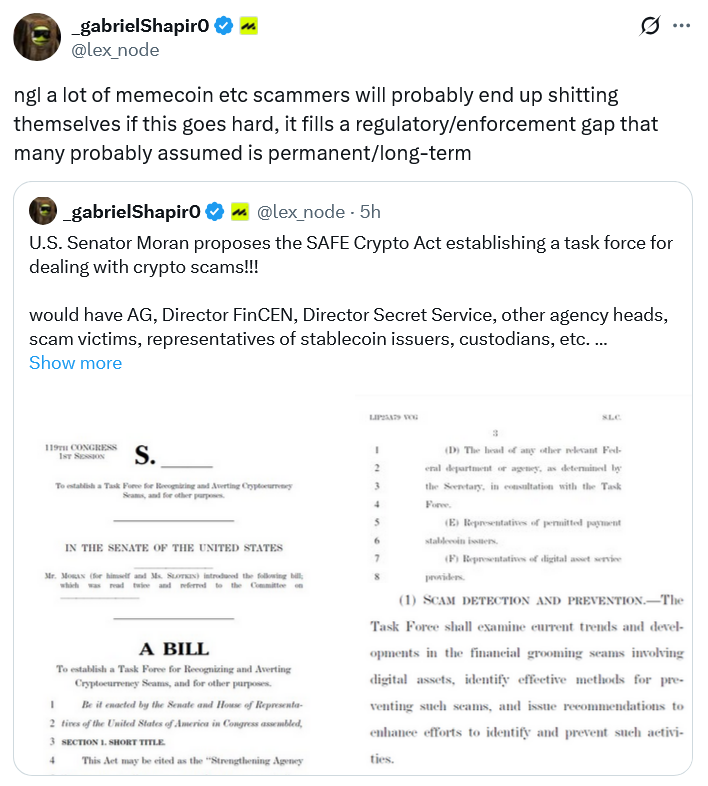
Source: Gabriel Shapiro
Perhaps most heartbreaking is who is being targeted. Seniors over 60 accounted for nearly $3 billion of those losses. These aren't just "investors" on paper; these are grandparents losing their life savings to sophisticated psychological manipulation and "pig butchering" schemes.
The most colorful endorsement of the bill comes from the legal world. Gabriel Shapiro, general counsel at Delphi Labs, didn't mince words when describing the potential impact on criminals. He turned to X to suggest that the involvement of high-ranking officials, such as the Director of the Secret Service and the head of FinCEN, would change the risk-reward calculation for scammers entirely.
“Scammers will probably end up shitting themselves if this goes hard,” Shapiro remarked.
It’s a blunt sentiment, but it reflects a growing frustration within the legitimate crypto industry. For years, builders and honest users have had their reputations tarnished by the actions of a few bad actors.
The government isn't going at this alone. Companies like TRM Labs, which specialises in blockchain forensics, are ready to provide the "eyes" on the ground. Ari Redbord, their head of policy, highlighted that the key to winning this fight is real-time disruption.
“By bringing industry and law enforcement together, we can meaningfully reduce criminals’ ability to exploit transformative technologies for harm.”
While the SAFE Act won’t erase crime overnight, it signals a shift in strategy. Instead of playing "whack-a-mole" with individual scammers, the US is building a net. If this legislation passes and is implemented with the intensity Shapiro expects, the "boots" of law enforcement might finally be heavy enough to make scammers think twice before their next move.