

Bitcoin faced a sharp and unexpected setback on Sunday, tumbling nearly 5% in just a few hours and triggering a wave of liquidations across the cryptocurrency market. The decline pulled the price down to roughly $86,950, a notable reversal after what initially appeared to be a stabilizing weekend for the world’s largest cryptocurrency.
For most of Saturday and early Sunday, Bitcoin seemed comfortably range-bound around $91,500, a level where it had been consolidating heading into the final stretch of November. Traders were closely watching to see whether the asset could break above resistance and start December with positive momentum. Instead, the market slipped into a rapid downturn, catching many off guard.
The retreat also came directly after Bitcoin posted its first green weekly close in four weeks, an early sign that buyers were regaining strength. But as has been the case many times throughout the year, weekend trading once again proved volatile. Commentators noted that Friday and Sunday nights are increasingly becoming periods where unexpected crypto price swings take place, often without any major news or catalyst driving them.
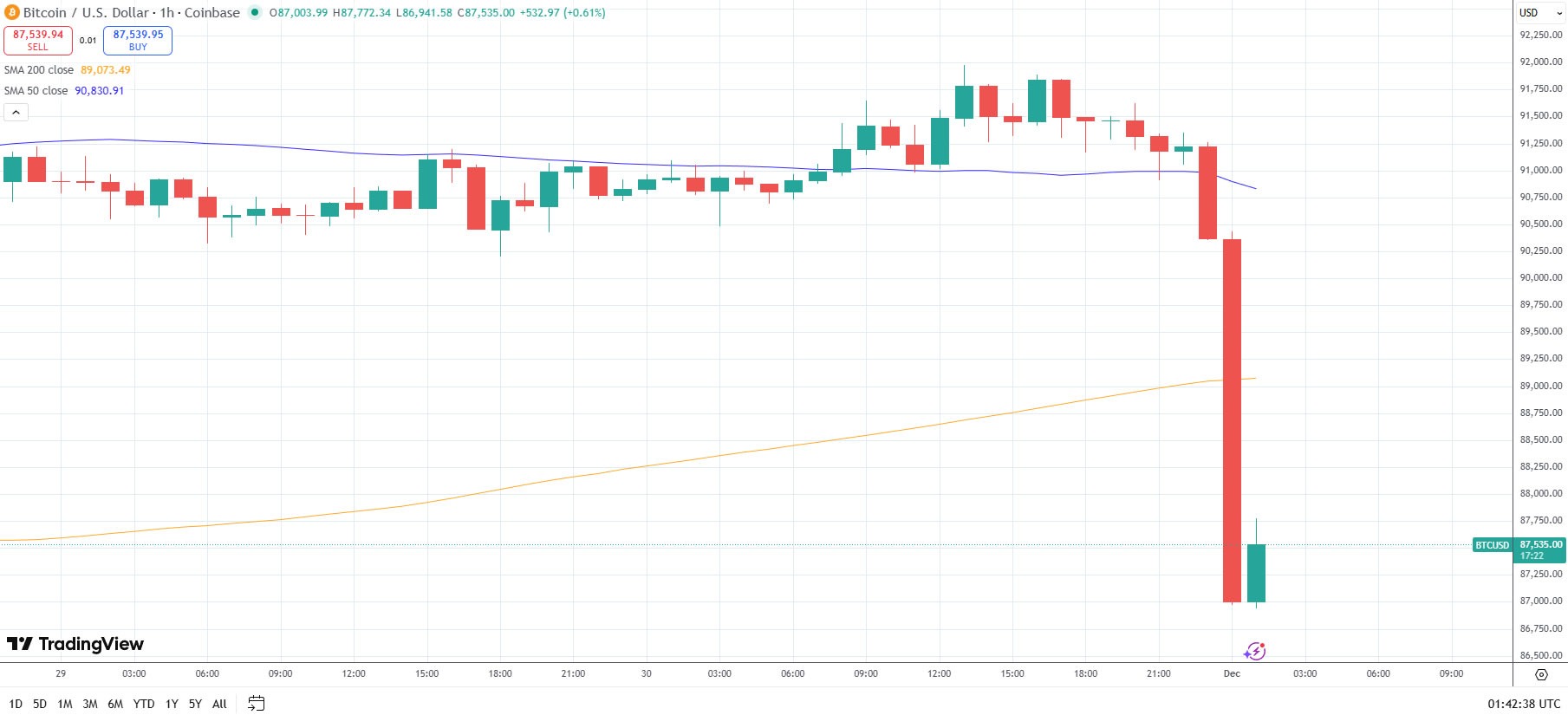
BTC dumps $4,500 in Sunday slaughter. Source: TradingView
Analysts pointed to a sudden burst of selling volume that quickly rippled through the market. With a large number of traders operating on high leverage, the initial dip rapidly snowballed into a broader sell-off as long positions began to unwind.
According to CoinGlass, more than 180,000 traders saw their positions liquidated within 24 hours. Total liquidations topped $539 million, much of it concentrated in the few hours following Bitcoin’s plunge. Close to 90% of these liquidations were long positions, mostly in Bitcoin and Ether, which meant the market was forced to clear out a significant amount of overextended bullish bets.
The Kobeissi Letter suggested that the sell-off wasn’t necessarily signalling a deeper collapse, describing the current downturn as more “structural” than fundamentally bearish. In other words, the broader market environment still appears intact, but excessive leverage continues to make Bitcoin vulnerable to sudden price shocks.
Sunday’s crash capped what turned out to be Bitcoin’s toughest month of the year. According to market data, Bitcoin closed November down 17.49%, marking its weakest November performance since 2018. That year, Bitcoin suffered a brutal 36% drop in the same month amid one of the harshest stretches of the previous bear market.
Despite the difficult close to November, not everyone is pessimistic. Market analyst Sykodelic pointed out that some of the necessary cleanup may have already taken place. With the CME gap filled and hundreds of millions in leveraged longs flushed out, he argued that the market may actually be setting the stage for a healthier trend. Clearing out downside liquidity early, he noted, is often a positive sign before any stronger upward move.